The Complete Guide to the BAH Calculator: Find Your Housing Allowance
What Is BAH?
Basic Allowance for Housing (BAH) is a monthly, tax-free payment designed to help service members cover housing costs when government quarters aren't available. Because BAH varies by location, pay grade, and dependency status, understanding how it works is essential for making informed financial decisions — whether you're budgeting at your current station or preparing for a PCS.
Key BAH Facts
| Feature | Details |
|---|---|
| Based On | Duty station ZIP code, rank, and dependency status |
| Updated | Annually, with rates effective January 1 |
| Tax Status | 100% tax-free — not included in federal or state taxable income |
| Rate Protection | Your rate won't decrease while you maintain eligibility at the same location |
| Overseas | OHA (Overseas Housing Allowance) replaces BAH for overseas duty stations |
How BAH Rates Are Determined
Each year, the Department of Defense surveys rental costs across every Military Housing Area (MHA). The survey accounts for:
- Local rental market data — median rents for apartments and townhouses in each area
- Utility costs — average electricity, gas, water, and sewer expenses
- Renter's insurance — standard policy premiums
- Pay grade tiers — higher ranks receive larger allowances, reflecting the DoD's housing standards for each grade
The BAH Formula
BAH = Median Housing Cost + Average Utilities + Renter's Insurance
BAH is designed to cover approximately 95% of housing costs for your area and rank. The remaining 5% is a small out-of-pocket cost share absorbed by the service member.
MHA Codes Explained
Every military installation falls within a Military Housing Area (MHA) identified by a unique code. Your MHA determines which rate table applies to you.
Common MHA Examples
| MHA Code | Area | Nearby Installations |
|---|---|---|
| VA312 | Norfolk/Virginia Beach | Naval Station Norfolk, JEB Little Creek |
| NC267 | Fayetteville | Fort Liberty (formerly Fort Bragg) |
| TX220 | Killeen/Fort Cavazos | Fort Cavazos |
| CA382 | San Diego | Naval Base San Diego, Camp Pendleton |
| CO209 | Colorado Springs | Fort Carson, Peterson SFB, USAFA |
| HI001 | Honolulu | JBPHH, Schofield Barracks |
Our BAH Calculator includes every MHA code and lets you search by ZIP code, city name, or installation.
With Dependents vs. Without Dependents
BAH is paid at one of two rates depending on your dependency status:
| Status | Eligibility | Rate |
|---|---|---|
| With Dependents | Married, or single with legal dependents | Higher rate |
| Without Dependents | Single, no dependents | Lower rate |
Typical Rate Differences (E-6, 2026)
| Location | With Dependents | Without Dependents | Difference |
|---|---|---|---|
| San Diego, CA | $3,648 | $2,946 | $702/mo |
| Norfolk, VA | $2,289 | $1,860 | $429/mo |
| Fort Cavazos, TX | $1,524 | $1,242 | $282/mo |
| Colorado Springs, CO | $2,100 | $1,716 | $384/mo |
| Honolulu, HI | $3,252 | $2,625 | $627/mo |
Rates are approximate and updated annually.
Pro Tip: Dual-military couples each receive BAH without dependents if they have no other dependents. If they have children, one member claims "with dependents" and the other claims "without."
Rate Protection
One of BAH's most valuable features is rate protection. If rates decrease for your area, your personal rate stays locked at the higher amount as long as:
- You maintain your current pay grade (or promote)
- You remain at the same duty station
- Your dependency status doesn't change to a lower-rate category
In practice, this means you'll never see a BAH decrease from one year to the next at the same station — even if area rents drop.
Pro Tip: Rate protection only shields you from decreases. If rates go up, you'll automatically receive the new, higher amount.
How to Use the BAH Calculator
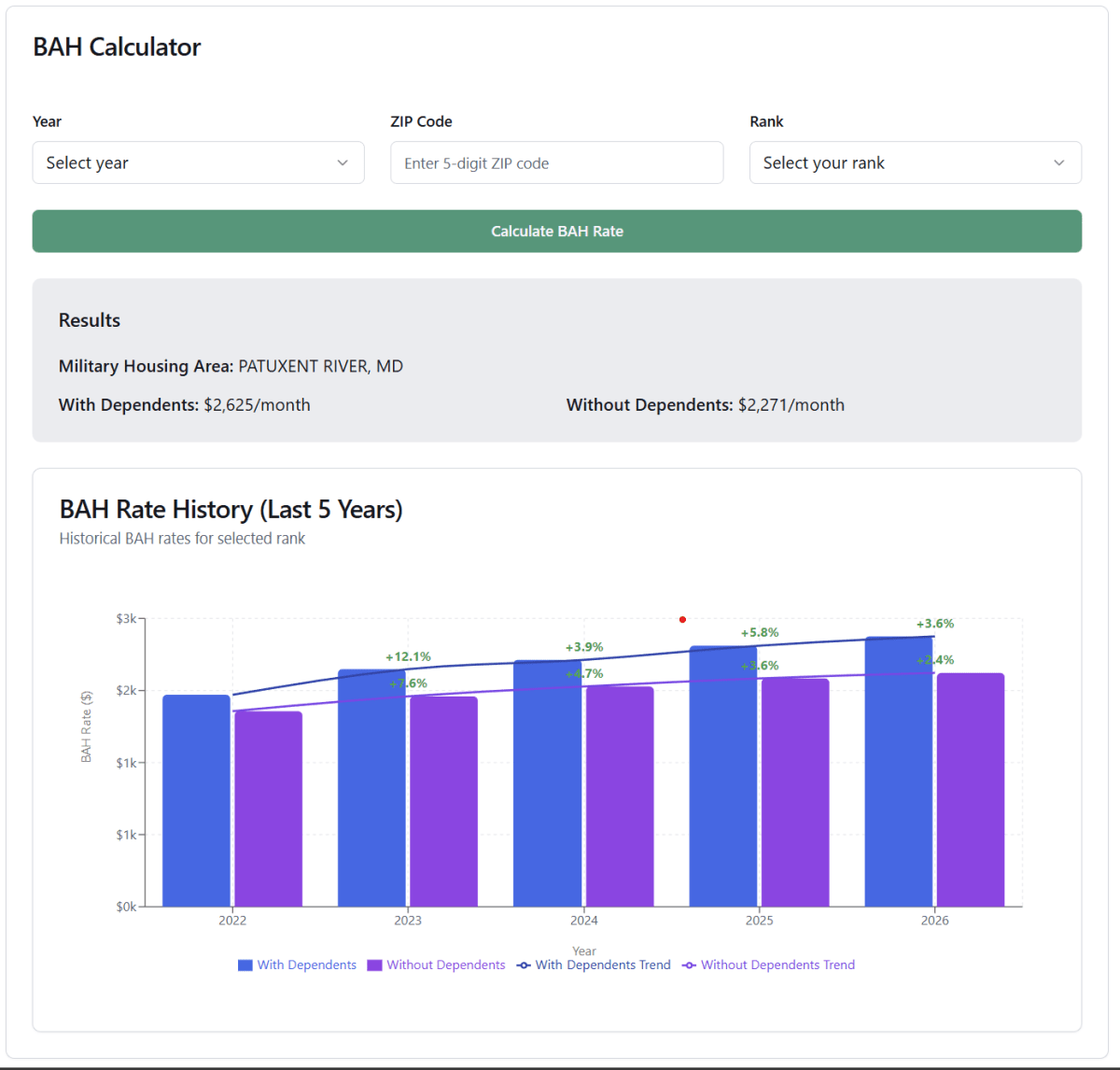
Our BAH Calculator gives you instant rate lookups and location comparison tools. Here's how to get started:

Step 1: Enter Your Information
Navigate to the BAH Calculator and enter:
- Pay grade (E-1 through O-10, W-1 through W-5)
- ZIP code or duty station (search by name or code)
- Dependency status (with or without dependents)
Step 2: View Your Rate
The calculator displays:
- Your monthly BAH rate
- Annual BAH total
- Comparison to the national average for your rank
- Historical rate trends for your area
Step 3: Compare Locations
Planning a PCS? Compare BAH rates across multiple duty stations:
- Search for potential new locations
- View side-by-side rate comparisons
- Factor in cost-of-living differences beyond BAH alone
Planning for PCS Moves
Your BAH rate changes when you PCS to a new duty station. Proper planning can make a real financial difference.
Before Your Move
- Look up the new location's BAH rate using the calculator
- Compare to your current rate — will your housing allowance go up or down?
- Research local housing costs — BAH covers roughly 95% of median costs, but individual markets vary
- Consider on-base housing — no BAH paid, but housing and utilities are provided
Cost-of-Living Considerations Beyond BAH
| Factor | High-Cost Area (San Diego) | Low-Cost Area (Fort Cavazos) |
|---|---|---|
| BAH (E-6 w/dep) | $3,648 | $1,524 |
| Typical Rent (3BR) | $3,200–$3,800 | $1,200–$1,600 |
| Grocery Index | 115 (15% above average) | 88 (12% below average) |
| Gas Prices | High | Below average |
| State Income Tax | Yes (CA) | No (TX) |
Pro Tip: A higher BAH doesn't always mean more money in your pocket. Compare the BAH rate to actual housing costs — sometimes lower-cost areas with smaller allowances leave you with more disposable income.
BAH Trends
BAH rates have generally risen over time, tracking the broader housing market:
National Average BAH Trends (E-6, With Dependents)
| Year | Average Rate | Year-Over-Year Change |
|---|---|---|
| 2022 | $1,842 | +5.1% |
| 2023 | $2,052 | +11.4% |
| 2024 | $2,142 | +4.4% |
| 2025 | $2,226 | +3.9% |
| 2026 | $2,316 | +4.0% |
Rates are approximate national averages. Individual MHA rates vary significantly.
The post-2020 housing boom drove some of the largest BAH increases in history. Rates have since stabilized at these elevated levels, with modest annual adjustments continuing.
BAH as a Tax-Free Benefit
Because BAH is entirely excluded from federal taxable income, its real value is substantially higher than the dollar amount alone suggests.
Civilian Salary Equivalent
To receive the same after-tax take-home as your BAH, a civilian would need to earn significantly more:
| BAH Amount | Tax Bracket | Civilian Pre-Tax Equivalent |
|---|---|---|
| $2,000/mo | 22% | $2,564/mo |
| $2,500/mo | 24% | $3,289/mo |
| $3,000/mo | 24% | $3,947/mo |
| $3,500/mo | 32% | $5,147/mo |
This tax advantage is one of the key reasons military total compensation is more competitive than base pay alone would suggest.
Tips for Maximizing Your BAH
- Live below your BAH — pocketing the difference is one of the simplest ways to build savings
- Consider roommates if single — splitting rent while collecting full BAH without dependents can accelerate savings
- Track rate changes — check new rates each January and adjust your budget accordingly
- Factor BAH into retirement planning — BAH stops when you separate or retire, so plan for that housing expense gap
- Use the calculator for every PCS — don't assume rates based on area reputation alone
Full Housing Analysis with Pro
Upgrade to Pro to integrate BAH into your complete financial picture:
- BAH rate lookups for any duty station in the country
- PCS comparison tools showing the full financial impact of a move
- Retirement transition planning that models the shift from BAH to out-of-pocket housing costs
- Export data for your personal financial planning
Try the BAH Calculator to look up your rate today.
Model it yourself
See what these numbers mean for your retirement
Run your grade, years of service, and retirement date through the calculator — in about a minute.
Open the calculator — free →This article is educational and not financial, tax, or legal advice. Figures are estimates and subject to change — verify details with official sources before making decisions.
Last updated January 9, 2026. Questions? Contact us or browse more guides.