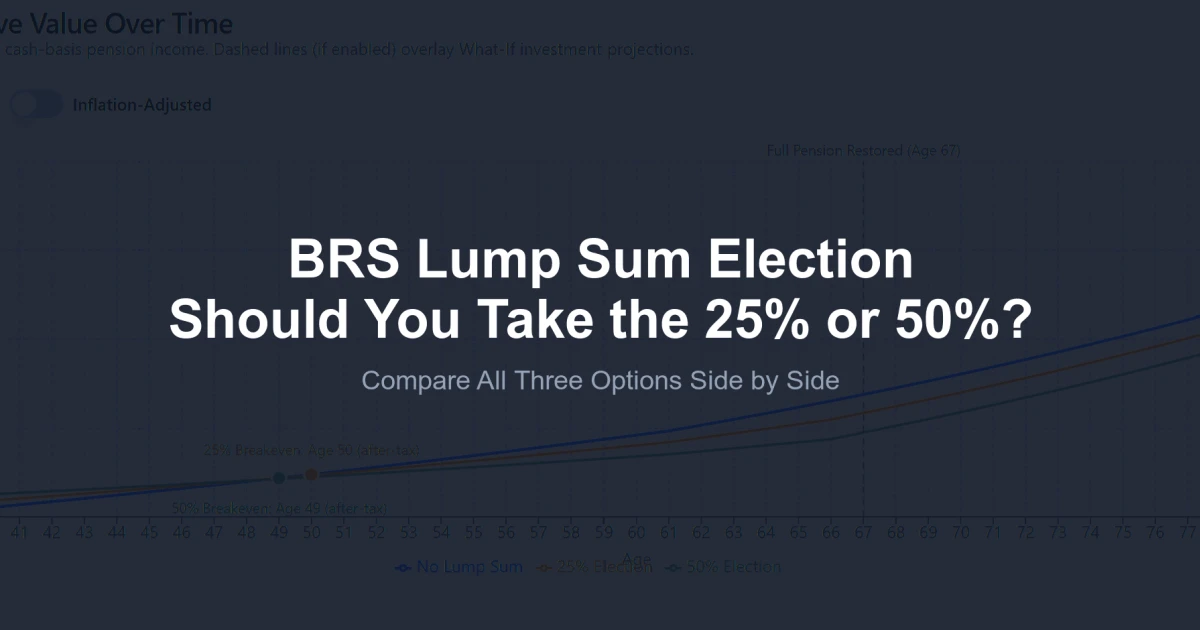
BRS Lump Sum Election: Should You Take the 25% or 50%?
What Is the Lump Sum Election?
The Blended Retirement System gives eligible service members the option to receive a portion of their future retirement pay as a single lump sum payment at retirement. You can elect to receive either 25% or 50% of the discounted present value of your future pension payments from retirement until age 67.
In exchange, your monthly pension is reduced until you turn 67, at which point your full pension amount is restored.
| Option | Lump Sum Amount | Pension Reduction | Full Pension Restored |
|---|---|---|---|
| No Lump Sum | $0 | None | N/A |
| 25% Lump Sum | 25% of discounted future payments | 25% reduction until age 67 | At age 67 |
| 50% Lump Sum | 50% of discounted future payments | 50% reduction until age 67 | At age 67 |
Pro Tip: The lump sum election must be made before retirement. Once you retire without electing the lump sum, you cannot go back and change your decision.
How the 25% and 50% Options Work
The Discount Rate
The lump sum is calculated using a discount rate tied to the Department of Defense's prescribed rate, which reflects the time value of money. A higher discount rate means a smaller lump sum; a lower rate means a larger one.
Example: O-4 Retiring at 20 Years, Age 42
Assume a monthly pension of $3,500 before the lump sum election:
| Scenario | Lump Sum Received | Monthly Pension (Age 42-66) | Monthly Pension (Age 67+) |
|---|---|---|---|
| No Lump Sum | $0 | $3,500 | $3,500 |
| 25% Election | ~$165,000 | $2,625 | $3,500 |
| 50% Election | ~$330,000 | $1,750 | $3,500 |
Amounts are illustrative. Actual values depend on the discount rate, COLA assumptions, and your specific pay.
Reduced Pension Before Age 67
The most important thing to understand is that your pension is reduced for what can be a very long time. If you retire at 40 with 20 years of service, your pension is reduced for 27 years before being restored at age 67.
Cumulative Impact of the Reduction
For an O-4 retiring at age 42 with a $3,500 base pension:
| 25% Election | 50% Election | |
|---|---|---|
| Monthly reduction | -$875 | -$1,750 |
| Annual reduction | -$10,500 | -$21,000 |
| Total reduction (25 years) | -$262,500 | -$525,000 |
| Lump sum received | ~$165,000 | ~$330,000 |
The raw numbers show you receive less in lump sum than the total pension you give up. That's because the lump sum is discounted to present value — the government accounts for the fact that a dollar today is worth more than a dollar 20 years from now.
Full Pension Restoration After 67
At age 67, your pension is fully restored as if you never elected the lump sum. This includes all COLA adjustments that accrued during the reduction period. Your pension doesn't skip the COLAs — they still compound on the full amount.
Pro Tip: The restoration at 67 is automatic. You don't need to apply or take any action — your pension simply returns to the full calculated amount with all accumulated COLAs.
Tax Implications
The lump sum is a significant tax event. Here's what you need to know:
First-Year Tax Spike
The lump sum is treated as ordinary income in the year you receive it. For a $330,000 lump sum, this could push you into a much higher tax bracket:
| Filing Status | Without Lump Sum (est.) | With $330K Lump Sum (est.) | Additional Tax |
|---|---|---|---|
| Married Filing Jointly | ~$8,000 | ~$75,000+ | ~$67,000 |
| Single | ~$12,000 | ~$90,000+ | ~$78,000 |
Estimates based on 2026 tax brackets. State taxes may apply depending on your state of residence.
Strategies to Reduce the Tax Hit
- Retire early in the tax year to receive the lump sum when you have less other income
- Roll a portion into a Traditional IRA (if eligible) to defer taxes
- Consider your state of residence — retiring in a no-income-tax state eliminates state tax on the lump sum
- Coordinate with your TSP withdrawals to avoid compounding the tax burden
Breakeven Analysis
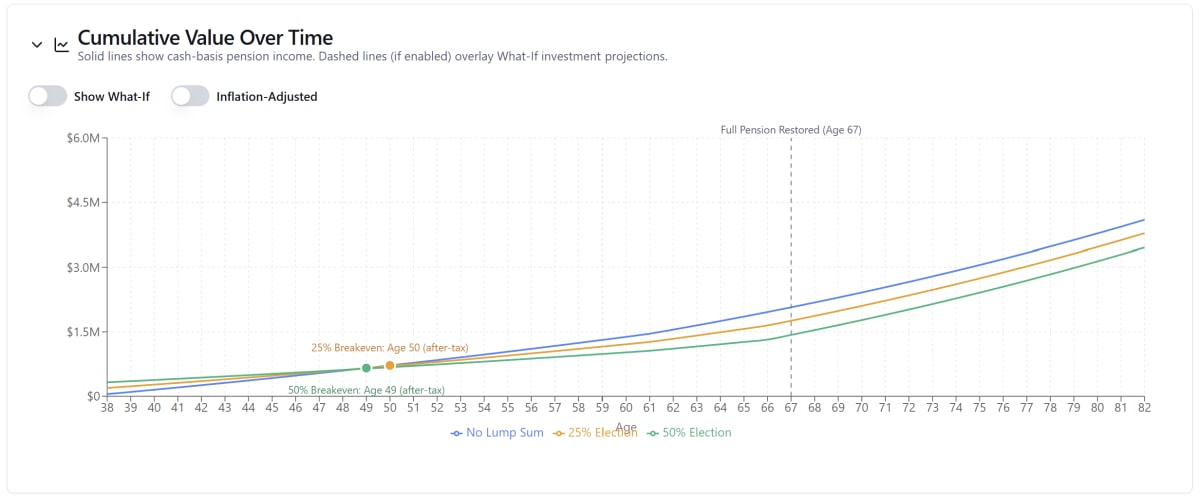
The critical question: How long does it take for the forgone pension payments to exceed the lump sum?
Simple Breakeven (No Investment Growth)
If you simply spend the lump sum and compare it to the reduced pension:
| Election | Approximate Breakeven |
|---|---|
| 25% | 15-18 years after retirement |
| 50% | 15-18 years after retirement |
Investment-Adjusted Breakeven
If you invest the lump sum wisely, the breakeven extends:
| Assumed Return | 25% Breakeven | 50% Breakeven |
|---|---|---|
| 4% | 20-22 years | 20-22 years |
| 6% | 24-27 years | 24-27 years |
| 8% | 30+ years | 30+ years |
At higher rates of return, the invested lump sum may never be caught by the cumulative pension difference — meaning the lump sum was the better financial choice.
Pro Tip: Use our Plan Comparison tool to model the exact breakeven point for your situation with different investment return assumptions.
Using the Plan Comparison Tool
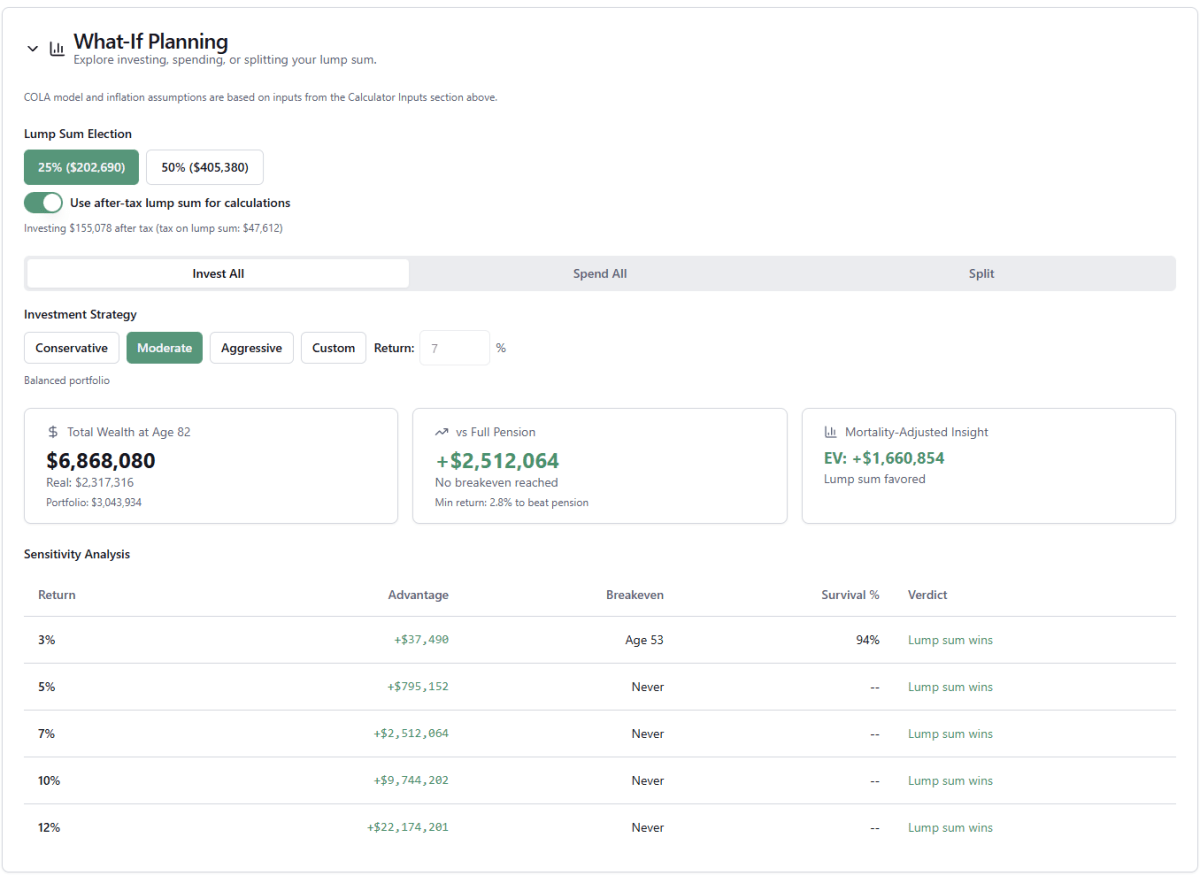

Our calculator makes this analysis straightforward:
- Create a baseline plan at Manage Plan with no lump sum election
- Duplicate the plan and set the lump sum election to 25%
- Duplicate again and set it to 50%
- Compare all three at Compare Plans to see the year-by-year impact on total income, net worth, and breakeven timelines
The comparison view shows:
- Side-by-side monthly and annual income projections
- Cumulative income over your lifetime
- The crossover point where the pension-only plan overtakes the lump sum plans
- Total wealth including invested lump sum returns
Who Should Consider Taking the Lump Sum
It May Make Sense If You:
- Have a specific high-return investment opportunity — real estate, business, or market investing with expected returns above the discount rate
- Retire young (before age 45) and have decades for compound growth
- Have a shorter life expectancy due to health conditions
- Need immediate capital for a home purchase or business start-up
- Are confident in your investment discipline and won't spend the lump sum
It May NOT Make Sense If You:
- Want guaranteed income without market risk
- Aren't comfortable investing or lack financial discipline
- Retire at age 55+ with fewer years for the lump sum to grow
- Have a family history of longevity — the pension will pay out for longer
- Need stable cash flow for monthly expenses without investment complexity
Common Mistakes to Avoid
- Ignoring taxes: The lump sum looks bigger before Uncle Sam takes his share
- Assuming high returns: Use conservative assumptions (4-6%) for planning
- Spending the lump sum: The math only works if you invest it
- Not considering inflation: Your reduced pension doesn't buy as much over 25 years
- Deciding in isolation: Consider your full financial picture — TSP, spouse income, VA disability
Model Your Decision
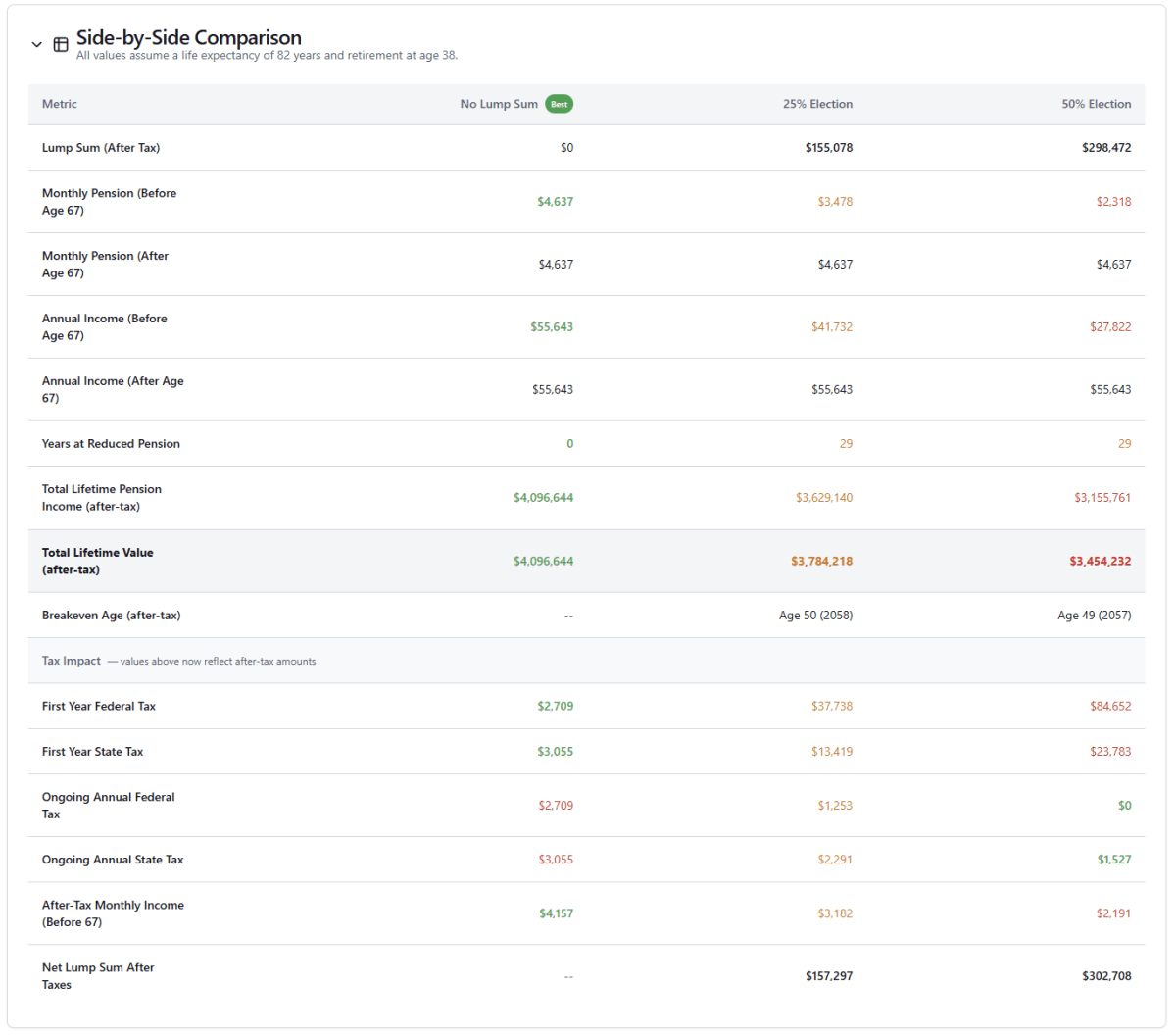
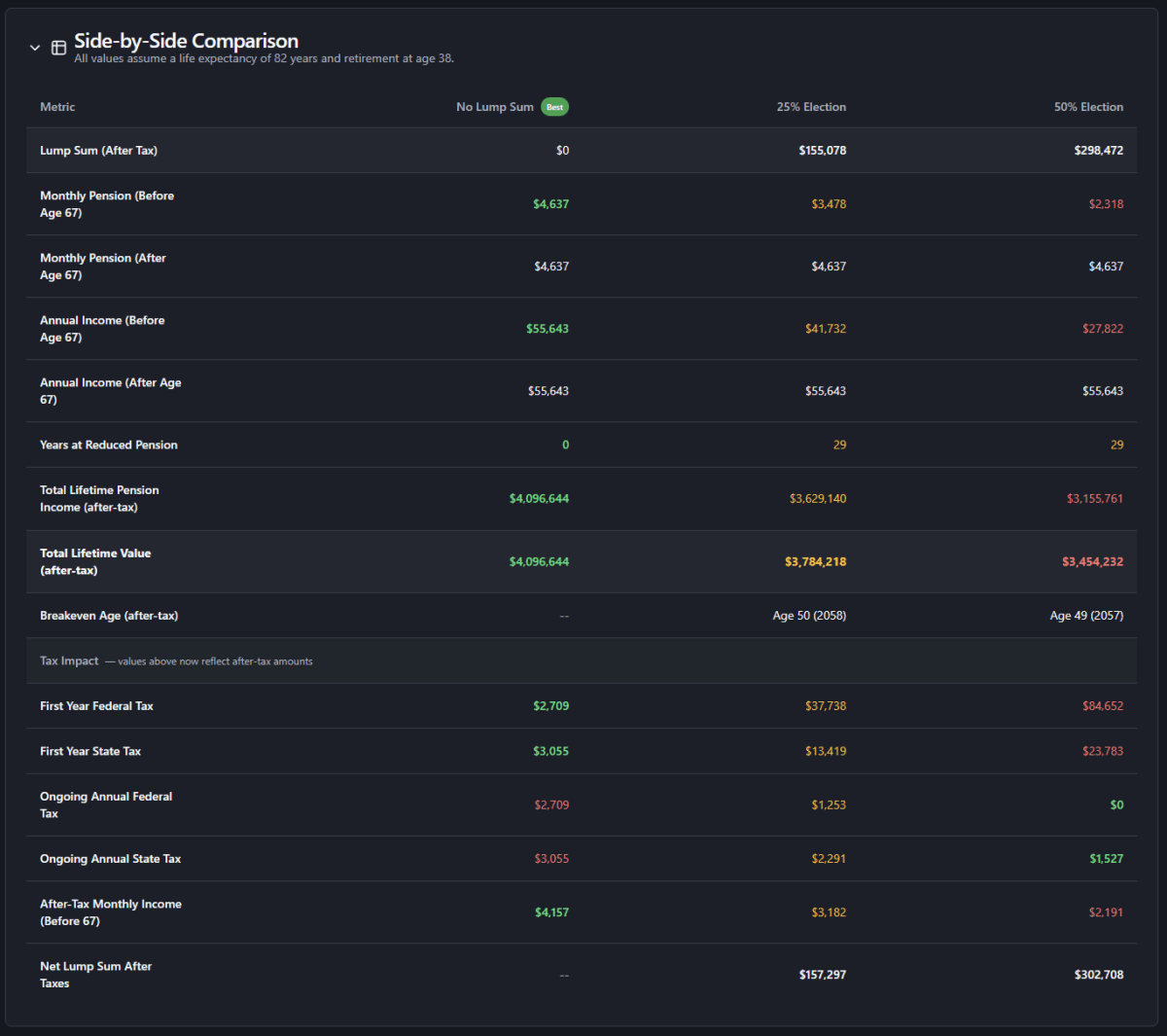
The best way to make this decision is with real numbers specific to your situation. Our retirement calculator lets you:
- Input your exact pay and years of service
- Model both lump sum options against the full pension
- Adjust investment return assumptions to stress-test the decision
- See the tax impact in your first year of retirement
- Compare total lifetime income across all scenarios
Create your retirement plan to start modeling your lump sum decision today.
Model it yourself
See what these numbers mean for your retirement
Run your grade, years of service, and retirement date through the calculator — in about a minute.
Open the calculator — free →This article is educational and not financial, tax, or legal advice. Figures are estimates and subject to change — verify details with official sources before making decisions.
Last updated February 9, 2026. Questions? Contact us or browse more guides.